

Quick answer
The mount toubkal trek 2 days itinerary splits the ascent into a 1,200-meter climb to Toubkal Refuge on day one (typically 5-6 hours from Imlil) and a 3-4 hour pre-dawn summit attempt on day two, followed by a 4-5 hour descent back to Imlil. The route gains 2,200 meters of total elevation and covers approximately 30 kilometers round-trip, with an overnight stay at 3,207 meters.
The path to North Africa's highest summit begins not at the trailhead but in the arithmetic: 2,200 vertical meters divided across two calendar days, with 960 meters tackled in darkness. Most trekkers arrive in Imlil between 07:00 and 09:00 to start the approach march while temperatures remain cool, threading through walnut groves and stone-walled terraces before the trail steepens into the Atlas high country. The Toubkal Refuge sits at the treeline's upper limit, a stone shelter where sleeping bags are laid shoulder-to-shoulder in communal rooms and the dinner hour doubles as a pre-summit briefing. Day one's rhythm is deceptively steady—1,200 meters spread across six hours translates to 200 meters of gain per hour, a sustainable pace that keeps the heart rate below conversation-killing levels. The route follows mule tracks carved by decades of porter traffic, crossing the Mizane Valley before switchbacking up scree slopes toward the refuge. Most parties reach the shelter by mid-afternoon, leaving time to hydrate, rest, and adjust to the 3,207-meter elevation before an early dinner. Guides typically enforce a 21:00 lights-out to ensure four hours of sleep before the summit attempt. The second day inverts the first: a 02:00 wake-up, a 03:00 departure under headlamp, and a four-hour grind up loose scree and frozen trail to reach the summit plateau by sunrise. The final 960-meter push climbs through sub-zero darkness, testing both navigation and nerve as the gradient steepens near the ridgeline. Summit attempts succeed or fail in the hours between 06:00 and 08:00, when clear skies and manageable wind create the narrow window for standing atop the 4,167-meter peak. The descent retraces the ascent route, dropping back to the refuge for breakfast before continuing down to Imlil, typically arriving by early afternoon. The two-day structure compresses what could be a gentler three-day acclimatization schedule into a weekend-friendly format. This compression carries consequences: acute mountain sickness rates climb when trekkers ascend 2,200 meters in under 36 hours, particularly those flying directly into Marrakech without prior altitude exposure. The mount toubkal trek 2 days itinerary favors fit hikers with recent high-altitude experience; those uncertain about their acclimatization ceiling should consider the three-day variant that adds an extra refuge night and a rest day at elevation.
“The second day inverts the first: a 02:00 wake-up, a 03:00 departure under headlamp, and a four-hour grind up loose scree and frozen trail to reach the summit plateau by sunrise.”
Mount Toubkal Trek 2 Days Itinerary: Day-by-Day Breakdown
This plan suits fit trekkers tackling the 4,167 m summit over two days with an overnight at Toubkal Refuge. Total walking time is approximately 10–12 hours split across both days.
Imlil to Aremd village
Drive or walk from Imlil (1,740 m) to Aremd; the trail begins here, ascending through walnut groves toward Sidi Chamharouch. Allow 2–2.5 hours to reach the shrine.
Sidi Chamharouch to Refuge
Steep climb on rocky switchbacks; altitude rises from 2,350 m to 3,207 m at Toubkal Refuge. Walking time 2.5–3 hours; arrive mid-afternoon to rest and acclimatise.
Summit push begins
Depart refuge in darkness; headlamp required. Ascend scree slopes and the south cirque; 960 m gain over 3–4 hours. Sunrise often coincides with final approach.
Summit and descent to refuge
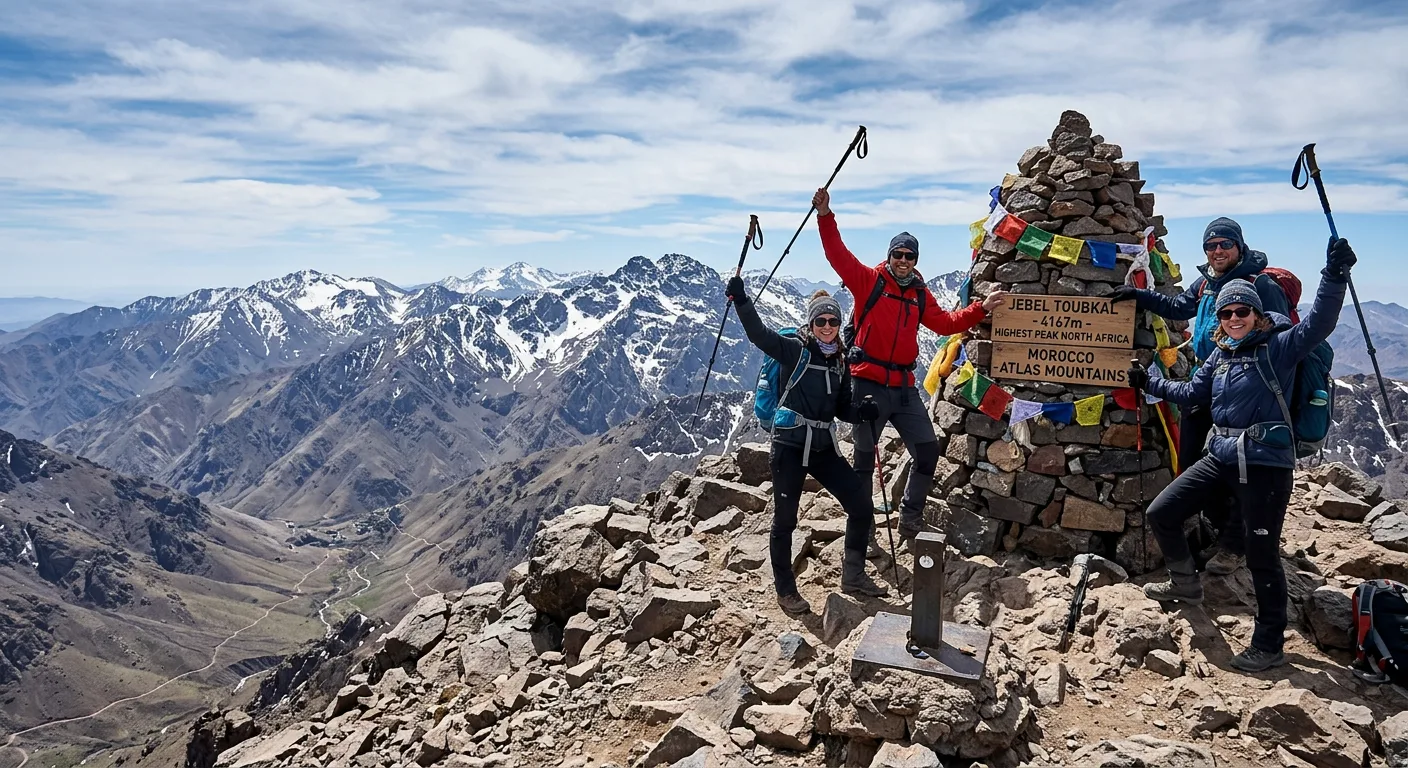
Reach the summit cairn at 4,167 m; views span the Atlas and Sahara edge. Descend to refuge for breakfast; total summit round-trip roughly 5–6 hours.
Refuge to Imlil
Retrace Day 1 route downhill; legs feel the 1,467 m descent. Walking time 3–4 hours; most groups reach Imlil by mid-afternoon.
Getting to the Mount Toubkal Trailhead in Imlil
Mount Toubkal's trailhead starts in Imlil, a village about 65 km south of Marrakech in the High Atlas, reached via the R203 road through Asni. Most trekkers arrive by grand taxi or private transfer directly from Marrakech, since Imlil has no train or metro access.
Grand taxi (shared) from Bab Doukkala or Place Jemaa el-Fna area, Marrakech, via R203 through Asni to Imlil
Private transfer or rental car, Marrakech to Imlil via the R203 mountain road through Asni
CTM or local bus, Marrakech to Asni, then grand taxi or local transfer onward to Imlil
Imlil village to the Toubkal trailhead marker and start of the ascent path
Best Time for a Mount Toubkal Trek 2 Days Itinerary
Late September through October and April into May give the most reliable footing for a two-day ascent, with daytime temperatures moderate and the Toubkal Refuge trail largely clear of ice on the standard route.
Spring (April-May)
Moderate, busier on weekendsDays 10-18°C, nights near freezing, snow lingers above 3500m
Snowfields can still cover the final scramble to the summit, so an ice axe and crampons are often still needed on the summit push even as lower trails clear.
Summer (June-August)
Highest crowds, especially AugustDays 25-30°C at Imlil, cooler and windy above the refuge
Heat makes the lower valley walk to Imlil draining, though the route itself is snow-free, letting the two-day plan run on its most straightforward footing.
Autumn (September-October)
Moderate, fewer groups than springDays 15-22°C, nights near 0°C at altitude
Stable weather and dry trail conditions make this the season where the standard two-day itinerary requires the least specialized gear.
Winter (November-March)
Lowest visitor numbersDays below 10°C, nights well below freezing, heavy snow above 3000m
Crampons, an ice axe and winter mountaineering experience become necessary, and the same two-day plan takes longer per stage in deep snow.
Early morning starts (any season)
Fewer people on the trail at dawn—
Setting off from Imlil or the refuge before the day warms keeps footing firmer on snow and avoids the midday sun on exposed switchbacks.
Verdict: For most trekkers, the last week of September through October offers the best balance of stable weather, manageable crowds and snow-free footing for the standard two-day route.
Pre-Trek Checklist for the Mount Toubkal 2-Day Itinerary
Secure permits, gear, and bookings before starting the 2-day Toubkal ascent from Imlil.
-
Book a certified mountain guide — Morocco law requires a licensed guide for Toubkal; arrange at least one week ahead.
-
Reserve refuge accommodation early — Toubkal Refuge bunks fill quickly in peak months; confirm your night's bed in advance.
-
Carry enough cash in dirhams — No card payment exists on the mountain for porter tips, refuge fees, or meals.
-
Pack four-season sleeping bag — Refuge nights drop below freezing year-round, even in summer.
-
Bring layered clothing for altitude — Temperature swings from warm valley starts to sub-zero summit mornings demand flexible layers.
-
Arrange porter services if needed — Porters carry main packs; book through your guide or Imlil cooperatives before departure.
-
Download offline maps — Mobile signal vanishes above Imlil; GPS tracks prevent route-finding errors on summit day.
Mount Toubkal Fees: Park Entry, Guides, Porters and Refuge Costs
Entry to Toubkal National Park carries no gate fee; what a trekker actually pays depends on required guide, porter, and refuge arrangements rather than admission itself.
A typical adult pays 0 MAD to enter the park, and the real cost swings on whichever guide, porter, and refuge package they book separately.
Mount Toubkal National Park Hours for a 2-Day Trek
Toubkal National Park has no gate and no daily closing time, it stays accessible 24 hours a day, every day of the week.
| Monday | 00:00 – 23:59 | No gate closure |
|---|---|---|
| Tuesday | 00:00 – 23:59 | No gate closure |
| Wednesday | 00:00 – 23:59 | No gate closure |
| Thursday | 00:00 – 23:59 | No gate closure |
| Friday | 00:00 – 23:59 | No gate closure |
| Saturday | 00:00 – 23:59 | No gate closure |
| Sunday | 00:00 – 23:59 | No gate closure |
Common Mistakes on the Mount Toubkal Trek 2 Days Itinerary
The two-day window leaves little margin for misjudgment. Most problems stem from underestimating altitude, pacing, or mountain-weather variables.
Starting the summit push after 05:00
Begin the final ascent between 04:00 and 05:00 to avoid afternoon storms and ensure daylight descent to the refuge.
Skipping acclimatization rest at the refuge
Spend the afternoon of Day 1 resting at 3,200 m; do not arrive late or push on immediately—your body needs time to adjust before the 4,167 m summit.
Wearing trail runners instead of ankle-supporting boots
The scree slopes and loose rock above the refuge demand stiff-soled boots with ankle support to prevent rolls and blisters.
Layering only a fleece and shell jacket
Pack a down or synthetic insulated jacket; temperatures drop below freezing at the summit even in summer, and wind chill intensifies exposure.
Arriving without a pre-booked licensed guide
Moroccan law requires a certified mountain guide for Toubkal; last-minute arrangements in Imlil cost more and may lack proper insurance or experience.
Underestimating water needs on the ascent
Carry at least 2 liters per person for the summit day; dehydration accelerates altitude sickness and there is no reliable water source above the refuge.
Check availability
FAQs: Mount Toubkal Trek 2 Days Itinerary
Everything you need to know about mount toubkal trek 2 days itinerary